
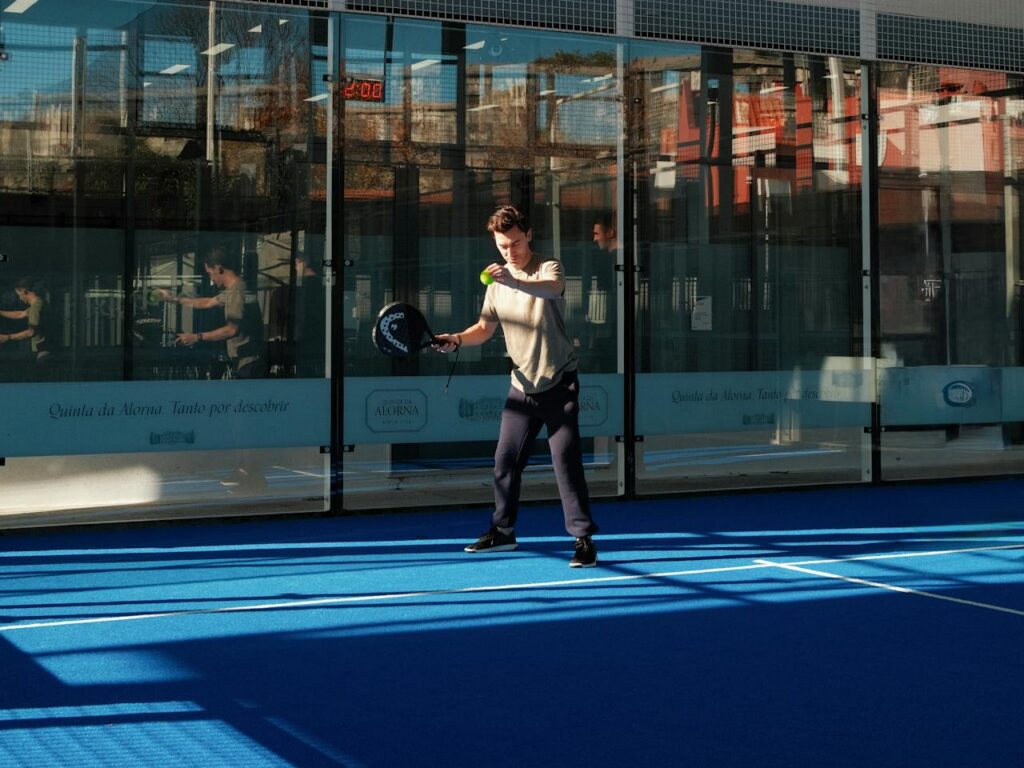
If you are transitioning from traditional tennis, you probably view your serve as your ultimate weapon. In tennis, a massive, explosive overhead serve can win you the point instantly in the form of an ace.
When you step onto the blue turf for the first time, you have to completely rewire that mindset. In padel, the serve is much more of a building shot to get you in a good position to win the point, rather than a shot meant to hit an ace. In fact, in professional padel matches, the serve only accounts for about 2% to 3% of all winners.
If you want to dominate your local matches, mastering your padel serve technique is the first step. Here is everything you need to know about the rules, the strategy, and the mechanics of hitting the perfect serve.
1. The Golden Rules of the Serve
Before you can work on strategy, you have to make sure your serve is perfectly legal. The rules here are entirely different from other racket sports:
- The Bounce is Mandatory: You must bounce the ball and then hit it diagonally into the opposite box.
- Keep it Under the Waist: You cannot bounce the ball above your waist level.
- Watch Your Feet: You need to keep both feet behind the white line.
- Bounce Placement: You must bounce the ball behind the white line before you move in to play it.

2. The Perfect Preparation and Motion
A great serve relies entirely on preparation and a compact motion. Here is how to set up your swing:
- The Grip: Use a relaxed continental grip, which looks like a handshaking grip with your pinky on the bottom.
- The Stance: Stand side-on with your left foot in front and your racket face pointing up.
- The Bounce: Do not drop or throw the ball hard; apply a little bit of downward pressure to bounce it just out in front of you and slightly to the right.
- The Swing: Use a high-to-low motion and gently brush the ball to generate backspin. You must avoid lifting the ball or using side-spin.
3. Court Positioning and Tactics
One of the biggest mistakes beginners make is trying to hit the serve as hard as possible from the wrong spot. Your court positioning dictates your success:
- Serve from the Middle: You should start a couple of steps behind the white line and close to the middle of the court. Serving near the middle allows you to easily target both the glass and the “T” without giving away your direction, and it makes your run to the net much easier.
- Target the Glass: Aim 80% to 90% of your serves toward the glass, as this is the trickiest place for opponents to return from. Throw an occasional serve down the “T” to keep your opponent guessing.
- Reduce Your Power: Serve at 60% to 70% power. Serving too fast reduces the time you have to reach the net position.

4. The Ultimate Video Masterclass
Understanding the rules is one thing, but perfecting the exact knee bend, racket face angle, and footwork takes visual repetition.
If you want to take your serve from a 6/10 to a 10/10, we highly recommend watching this incredibly helpful step-by-step breakdown from Everything Padel.
Watch: How To Play The Perfect Padel Serve | Learn In 8 Minutes
5. Master the “Serve and Volley” Combo
Once you have watched the video and understand the mechanics, it is time to put the ultimate attacking combination into practice.
The primary aim of your serve is to win the net position. After you hit the ball, you should always run to the net rather than staying at the back of the court. If you serve down the “T” or out to the glass, make sure you play your next volley straight into the open space to secure a brilliant attacking combination.

Put Your New Serve to the Test Today
The only way to develop muscle memory is through repetition. You can’t perfect a slicing underhand serve by reading about it—you have to get on the turf and hit buckets of balls.
Grab a partner (or just a basket of balls) and book a court to dial in your mechanics.